Yacht Shipping by Vessel
International yacht transport on cargo vessels, including RoRo, LoLo and semi-submersible ships. We manage method selection, loading coordination, securing and delivery to the destination port.
See all yacht transport options in our Yacht Transport Services Hub.
Popular shipping ports
Find your destination on the map below. Only mail ports are shown. Contact us, if you would like to load or unload your boat in another place of the World.
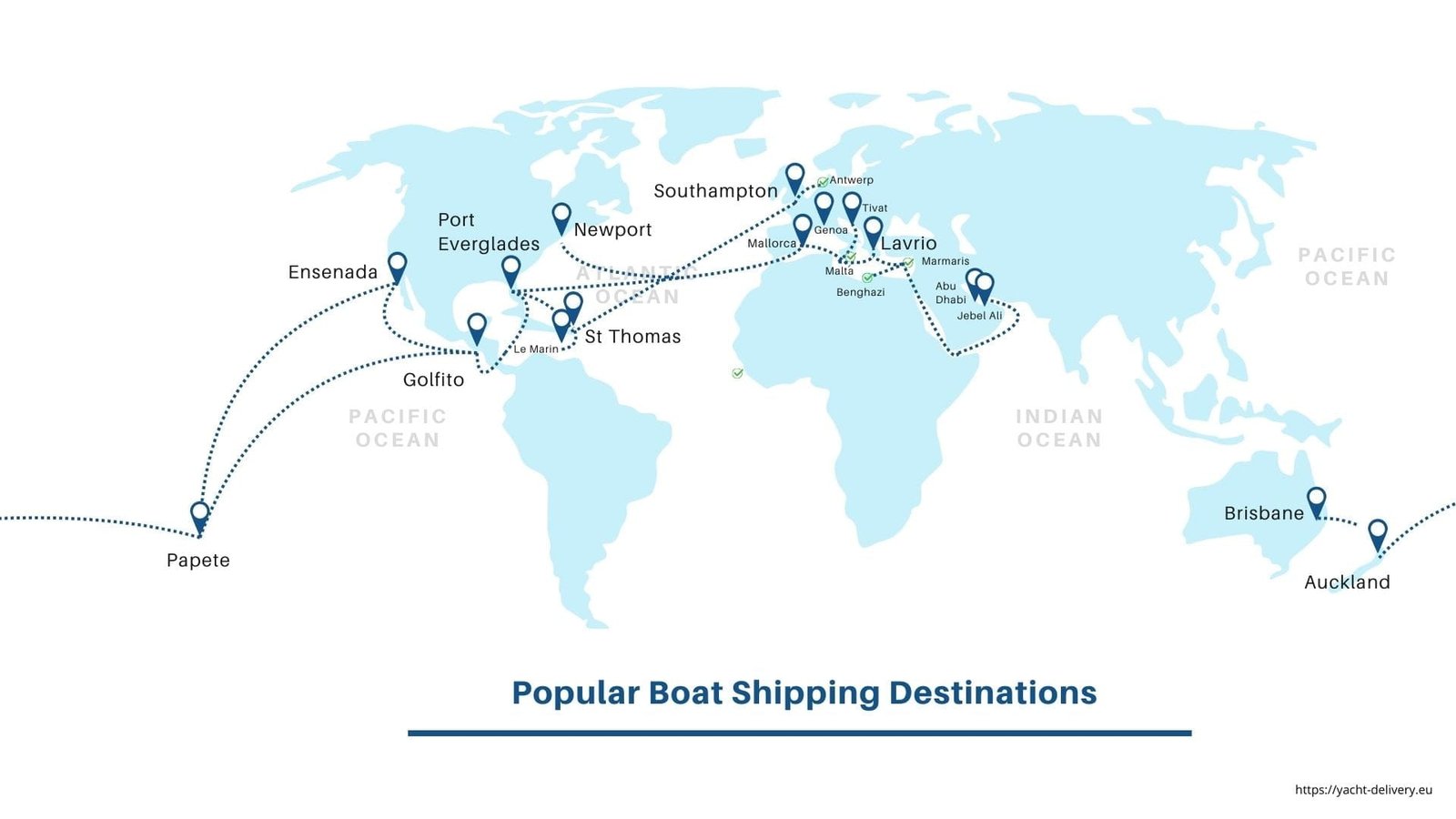
The map shows common loading and discharge ports on popular routes. If you need another port (Far East, South America, islands), tell us your preferred location—we’ll check schedule availability and options.
Why Choose Our Boat Shipping by Vessel Service?
Zero engine hours: your yacht arrives without passage wear and operational mileage.
Controlled loading & securing: lashing/blocking arranged for sea transport, with documented handover.
- Engineered shipping cradle (not just a yard stand): we plan hull support and securing as an integrated system for sea transport, so loads are distributed correctly during the voyage.
- Loading/unloading supervision (Loadmaster accountability): the highest-risk phase is the lift/float-on operation—supervision and condition documentation at handover reduce misunderstandings and damage risk.
Method matched to the yacht: RoRo/LoLo/semi-submersible selected by dimensions, weight and route.
Predictable logistics: port schedules and loading windows planned in advance.
Insurance clarity: we explain carrier liability vs optional transit cargo insurance
Understand Boat Shipping Contract
Our Boat Transport Methods
1. Roll-on/Roll-off (RoRo) Ships
Ideal for trailered boats and vessels with their own propulsion. RoRo ships offer easy loading and unloading via stern or side ramps. This is an efficient solution, allowing for the transport of multiple vessels simultaneously.
KEY ADVANTAGES
- Swift loading and unloading process
- Ability to transport additional equipment
- Economical solution for smaller and medium-sized boats
- Regular sailings on popular international routes
Best for trailerable boats or yachts transported on a frame that can roll on/off via ramp.
2. Lift-on/Lift-off Vessels
Excellent for heavier yachts, motorboats, and sailboats. These ships utilise advanced deck cranes for precise loading and unloading.
Main Features:
- Capability to transport vessels of various sizes
- Precise placement of boats on deck or in the hold
- Advanced securing systems ensuring stability
- Protection in the hold against weather conditions
- Qualified crane operators ensuring safe manoeuvring
Best for sailing and motor yachts requiring crane lift; common on transoceanic routes.
3. Semi-submersible Ships
A unique solution ideal for superyachts and larger vessels. These ships partially submerge, allowing boats to float directly onto the deck
Advantages:
- Ability to transport several large yachts simultaneously
- Minimal risk of damage during loading
- Excellent stability during transport
- Capacity for long ocean voyages
- Advanced stabilisation systems minimising roll
Best for large yachts where float-on/float-off reduces lifting risk during loading.
4. Specialised Yacht Carriers
Designed specifically for transporting valuable boats and yachts, offering the highest level of protection and stability.
Key Features:
- Customisation of the interior to specific dimensions of transported vessels
- Advanced securing and climate control systems
- Continuous monitoring of transported vessels’ condition
- Protection against salt water and UV radiation
- Experienced crew specialising in handling luxury yachts
Selected for high-value yachts where securing standards, monitoring and protection are priority.
5. Container Ships
An economical solution for smaller boats that can be safely placed in containers. Ideal for long-distance transport.
Advantages:
- Excellent protection against weather conditions and damage
- Ability to transport boats along with equipment
- Ease of organising door-to-door transport
- Lower insurance costs due to increased security
Option for smaller boats that fit container dimensions and can be secured inside with equipment.
Sailboat Insurance
In vessel shipping, standard carrier liability is not the same as full-value yacht coverage. Before booking, confirm what your hull policy covers during commercial transit and consider dedicated transit cargo insurance for loading/unloading and voyage risks.
General Average
General Average is a maritime rule where cargo owners may share certain emergency costs of a voyage, even if their yacht arrives undamaged. In some cases, cargo can be held until a guarantee or security is provided. Ask your insurer whether your transit coverage includes General Average protection.
OUR TRANSPORT PROCESS:
Consultation & method selection: choose RoRo/LoLo/semi-sub based on yacht parameters and route.
- Loading window: Scheduling may require a loading window to align with carrier operations—your yacht must be ready and accessible during that period.
Preparation: readiness checklist and documentation requirements.
Loading coordination: lift/float-on planning, cradle/support points verification.
Securing on board: cradle/support plan and lashing arrangement prepared for sea passage, with photo documentation of the final setup.
Delivery: discharge coordination and handover condition documentation.
- Monitoring: Ocean freight schedules can change due to port operations and carrier routing; we provide updates and revised ETAs when needed.
Choosing the right yacht transport method
| Feature | Shipping by Vessel | Skipper Delivery | Boat Hauling |
|---|---|---|---|
| Best for | Transoceanic and intercontinental transport | Short to medium sea passages | Continental and regional moves |
| Typical distance | Hundreds to thousands of nautical miles | Coastal / offshore routes | Overland routes |
| Engine hours | None | High (full passage) | None |
| Wear & tear | None during transit | Sails, rigging, engine, systems | Minimal (road vibration only) |
| Weather exposure | None (cargo vessel) | Full exposure | None |
| Schedule predictability | Medium (port schedules, loading windows) | Low (weather & crew factors) | High |
| Main risks | Loading/unloading, shared maritime liabilities | Weather, mechanical failure, crew fatigue | Route limits, lifting on/off truck |
| Typical use cases | New yachts, seasonal relocations, high-value units | Experience sailing the boat, delivery under own power | Yard transfers, refits, seasonal land moves |
If you’re unsure which method fits your route and yacht, we’ll help you choose the safest and most efficient option.
Important points yacht owners often overlook
Loading window: cargo vessels operate on fixed port schedules—your yacht must be ready and accessible during the agreed loading period.
Carrier liability vs insurance: standard carrier liability is not the same as full-value yacht coverage during transit.
Loading supervision: the highest-risk moment is lifting or float-on/float-off—clear supervision and documentation matter.
Port readiness: delays often result from incomplete documentation or yard/port access issues, not the sea voyage itself.
Transit variability: ocean freight schedules may change due to port operations or route adjustments; updated ETAs are normal.
WHY clients choose our company
- 15 years of experience in boat transport
- Full cargo insurance
- Hundreds of satisfied clients
- Regular sailings to the most popular destinations
- Support with Sailboat Insurance
- Loading/unloading supervision and condition documentation at handover.
We offer competitive and transparent pricing, taking into account the dimensions and weight of your boat, transport route, and additional services. Whether you own a small recreational boat, a luxury yacht, or run a company dealing in watercraft, we have the ideal transport solution for you.
Contact us today to receive an individual quote and advice on the best solution for your boat. Trust the professionals – your boat deserves a safe journey!
If you prefere to move your yacht alone don’t forget to read our blogs about:
Yacht Shipping by Vessel – Service Overview
Yacht shipping by vessel is a professional sea transport service designed for moving sailing yachts and motor yachts across long distances without sailing the boat under its own power. The service covers international transport using specialized cargo ships, including Roll-On/Roll-Off (RoRo), Lift-On/Lift-Off (LoLo), semi-submersible vessels and dedicated yacht carriers.
The scope of service includes selection of the appropriate transport method, loading and unloading coordination, securing the yacht on board, sea passage monitoring and delivery to the destination port. Transport solutions are selected based on yacht dimensions, weight, rig configuration and route availability.
Yacht shipping is commonly used for transoceanic relocations, seasonal transfers between cruising regions, delivery of new yachts, participation in regattas and avoidance of long offshore passages. Compared to sailing delivery, transport by vessel eliminates engine hours, reduces mechanical wear and removes exposure to weather-related risks.
Depending on the route and vessel type, the service may include insurance options, preparation support and documentation required for international transport. Yacht shipping by vessel is considered the most predictable and controlled solution for long-distance yacht relocation.